Monday, November 21, 2011

Easy peasy vegan squeezy

Pete with his giant homegrown pumpkin
One of the things we have started to focus on as a group is how we will eat together in the cohouse once we have moved in. We're aiming for at least three evening meals a week, maybe (ideally) more, maybe some breakfasts, brunches and lunches as well. Thanks to Mark, who has spent time visiting other cohousing communities in Scandinavia and the US, we know quite a bit about what works well and what doesn't. The main lessons from others are that a) food is central to community -- we have to get it right, and b) it's not easy to get it right -- every community is different, and we need to be prepared to learn and adapt as we go along.

There's a long-standing commitment to cooking and eating predominantly vegan food at our communal meals. There are lots of good reasons for this but it's also something that causes many of us some anxiety -- I have to cook food that 40 people will enjoy eating *and* it has to be vegan? How is that ever going to work?

Lucy and Eliza saying 'how much garlic?!'
So last Friday, Mark (who picked up a lot of his vegan cookery skills when he lived in Italy) offered to host a participatory demo afternoon at his house to show some of us how it can be done. I was very keen to go -- I love food, and I love cooking, and I haven't eaten meat since I was a teenager -- but I'm not a vegan: indeed one of my mottos is 'there's no such thing as too much cheese'.

We started with a huge pot of chickpeas, a giant pumpkin from Pete's allotment, and three bulbs (yes, bulbs!) of garlic. Also involved at various stages, were rice, pasta, red peppers, nori, tofu, bouillon, olive and rapeseed oil, peas, potatoes, beans, lentils and chilli... not forgetting those traditional English ingredients: parsley, sage, rosemary and thyme. We made six or seven different dishes over the afternoon, and ate them all as we went along. I think we all had different favourites, but my personal favourite was the chickpea and pumpkin stew, which had smoky chilli plus slow cooked *and* deep fried garlic. Delicious. Lucy was looking after baby Eliza so couldn't do much chopping, but that did mean there was someone to write all the recipes down!

The deep-fried garlic gets added to the chickpeas
By the end of the afternoon... well, I believe Mark could cook tasty vegan food for 40 people with no problems at all. As for the rest of us, especially those who are used to relying on meat, fish or cheese for our strong flavours, I think we might need to work on our confidence -- and get used to starting to cook a whole lot earlier in the day than we're used to.

Having said that, Miles and I used some of the leftover pumpkin the next evening and cooked pasta for Pete and Dawn using an adapted recipe of Mark's, adding some toasted sunflower seeds and serving it with some kale with lemon and (yet more) garlic. If I say so myself, it was pretty good. I'm still not a vegan, but in a world where the US Congress will bow to big industry pressure and allow frozen pizza to be classified as a vegetable on school dinner menus, I want to be doing More Of This Kind Of Thing.

jo

www.lancastercohousing.org.uk

Saturday, November 12, 2011

Build Photos

Here are a few photos of the site from Friday 9th November...

Cohouse rising up

Terrace D rockface

Concrete foundation in terrace B

Underpinning of the wall next to the Cohouse


Thursday, November 3, 2011

Keeping the rock face beautiful

The houses in terrace D at the east end of the site look out on a sandstone rockface to the north (and over the river to the south).  The problem with building houses at the bottom of a rockface is we have to ensure that residents and their visitors are not put in danger from possible rockfalls!

A common way of dealing with this is to cover the entire rockface with wire netting - not particularly attractive, as this photo from a different site shows.  Unfortunately this is the type of solution that the first contractors we asked to look at the risk proposed...  In our case the stone wall above the face would have been covered in net too.
However we now have a more acceptable proposal (below) which looks at the risk that each particular section of rock presents and uses bolts of varying lengths depending on the condition of the rock.  We are now looking to progress a solution of this type as quickly as possible, so that we can get on with building Terrace D.

www.lancastercohousing.org.uk

Wednesday, November 2, 2011

It's November and the first house walls are six foot high

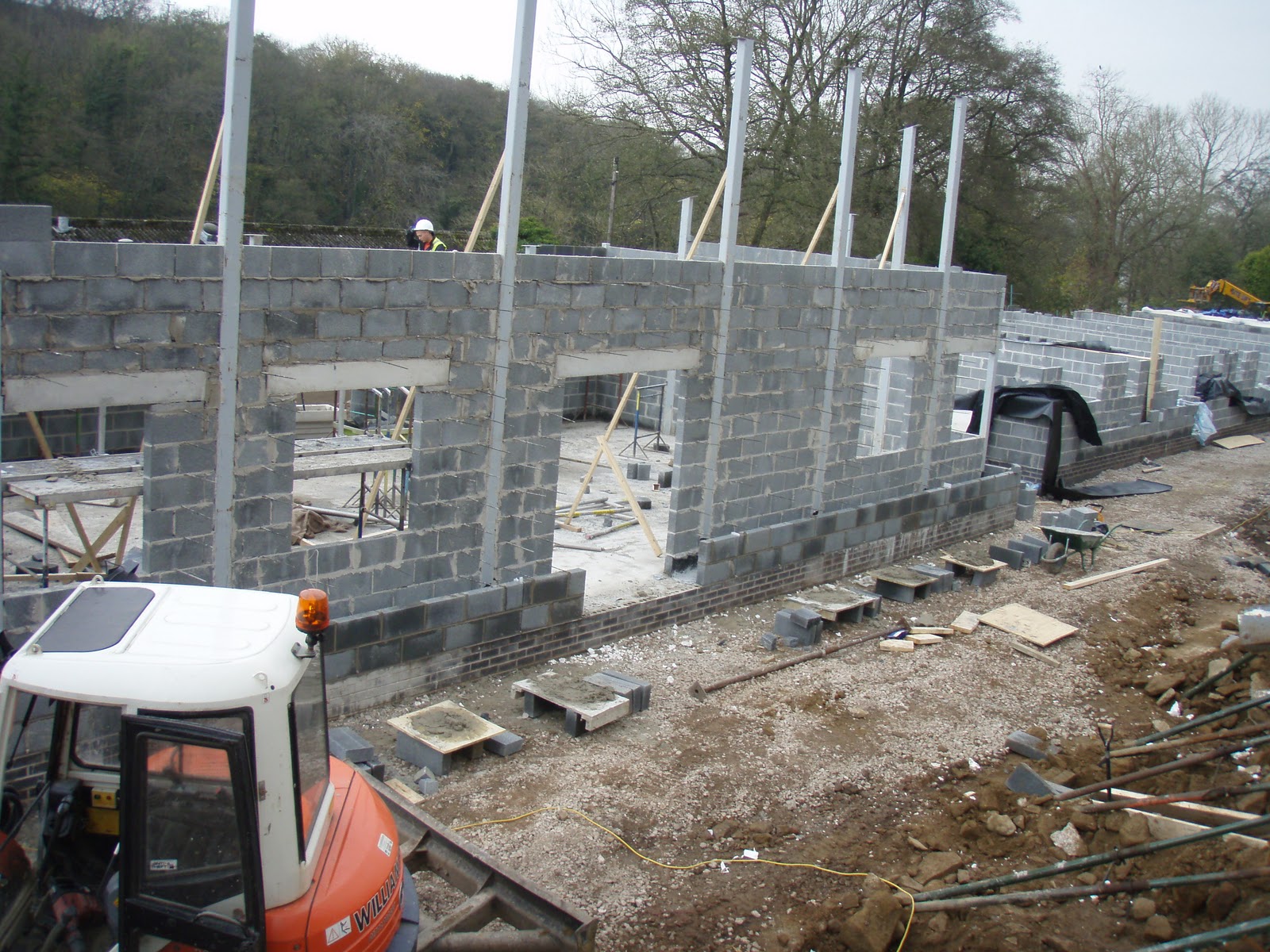
Hot off the press, these photo's were taken just before today's progress meeting with the contractors and design team.  The walls of terrace A are now rising - one leaf of the cavity wall goes up, then the insulaltion is fitted with the basalt cavity ties passing though it, before the other leaf of the wall is built.


Terrace A is actually a couple of weeks behind programme at the moment, but enough progress has been made to get a good feel for this part of the street, and also to see that there will be a good view from the north bedrooms of terrace A over the bike store to the fields and trees beyond.

The next picture shows the retaining wall that will be at the back of the common house toilets and guest rooms being propped whist it is underpinned.  The floor of the common house main building is in the foreground.

Meanwhile the rock anchoring to the retaining wall behind Terrace F, the 3 storey units, has been completed.  This wall isn't going anywhere!


Terrace B is also making progress.  These are the foundations of plot 10:-


The weather hasn't been the best, and there is a lot of water about.  Fortunately the fishing season is now over and no one else needs to pass through the site

We've had some sample gabion baskets made up.  The one on the left is made up of the crushed remains of the buildings we demolished whilst the one on the right is from sandstone from the site.  Unfortunately there is unlikely to be enough material from the site suitable for putting in gabions, especially as it is unlikely that we will be able to use brick at the front of gabions due to the risk of weathering...
so we are also looking at using some imported material.  In the photo below we have limestone in the gabion basket to the front and sandstone in the one to the rear.  Despite the fact we are in a sandstone area in Halton Gorge, the nearest quarries, around the Kellets, are limestone.  Ironically the sandstone has to be transported from a quarry near Chorley.  On the left is the reclaimed sandstone.  We are looking in more detail at the costs, aesthetics and environmental impacts of the various options before taking a decision.


http://www.lancastercohousing.org.uk/

Saturday, October 29, 2011

The missing link - at the Lune Aqueduct

Five or ten minutes cycle ride downstream from Forge Bank, another construction project is well underway.  British Waterways are carrying out various repairs and improvements to the Grade 1 Listed aqueduct which carries the Lancaster Canal over the River Lune.

If you are reading this and don't live in Lancaster, you might not know that both the river and the canal have tarmaced cyclepaths alongside them, but until now they have been linked by some steep and narrow steps.


Not only are the steps being widened...


but also a new cycle path is being built up a relatively gentle ramp to link the riverside cyclepath to the towpath...


...emerging just before the canal crosses over the A683 Caton Road on another bridge.  
According to workmen on site, the ramp is due to open in January 2012


Why am I writing about this on the cohousing blog?  Because once the new ramp is open, it will be much easier to cycle from Halton to a whole host of destinations close to the canal, including the Dukes Theatre, canalside pubs, the Gregson Arts and Community Centre, White Cross and the Hospital.  The towpath isn't lit, so its not the first choice after dark, but the rest of the time it makes a excellent route to the whole east side of the city centre and beyond.


www.lancastercohousing.org.uk